Cardo Packtalk Edge analysis
DMC mesh, JBL audio, IP67, and the battery claim an independent test disputes.
Retailer links on this page may be affiliate links (none carries an affiliate ID yet). Affiliate disclosure
Cardo vs Sena
Cardo is the better all-around choice for most riders: the Cardo Packtalk Edge is rated IP67 and lighter at 47 g. Group size no longer separates the two: the Edge takes up to 31 riders with the Mesh Boost update, the Sena 50S up to 24 riders in a private Group Mesh. The Sena answers with a longer claimed range and Harman Kardon speakers.
Short version
The short version, before the detail.
Side by side
Values from the maker specifications in our product data. Ranges and battery times are claims.
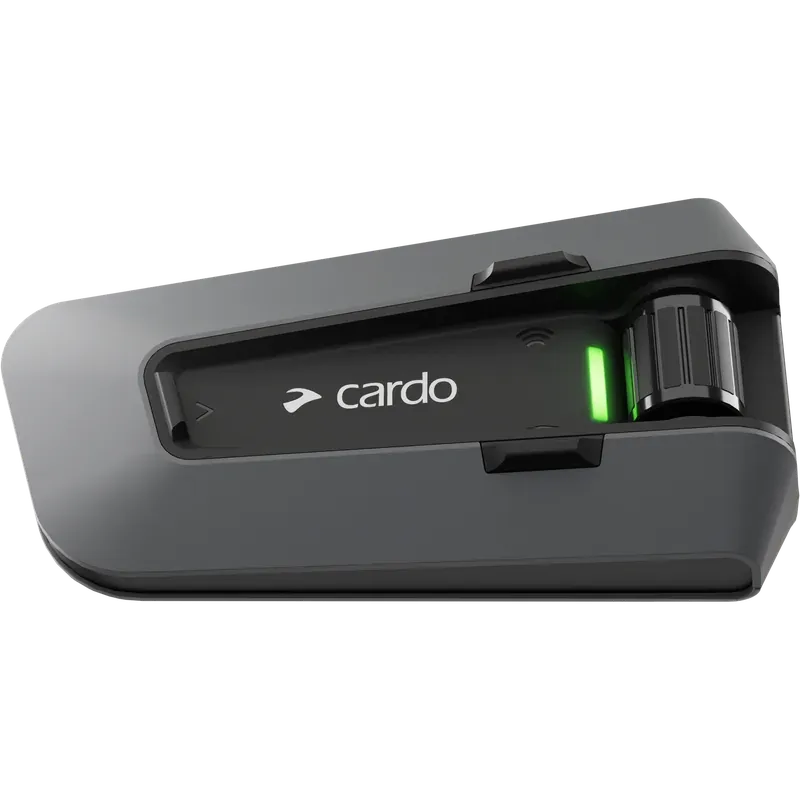
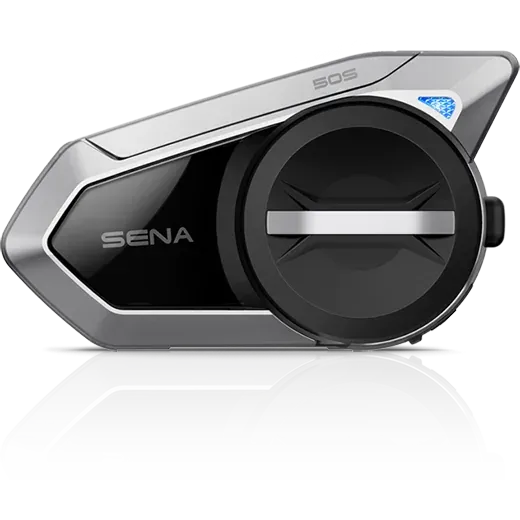
Left: Cardo Packtalk Edge. Right: Sena 50S. Prices checked November 2026. The two brands pair with each other over standard Bluetooth only, not over mesh.
Cardo Mesh Boost: up to 31 riders needs firmware 5.4 or later and the Cardo Connect app 9.1 or later on every unit. A group with any unit that has not been updated is limited to 15. Source: Cardo Mesh Boost FAQ, checked November 2026.
In depth
Both brands use mesh networking for group riding. Cardo’s Dynamic Mesh Communication (DMC) forms the group when the units are switched on and keeps it together when one rider pulls over or falls out of range: the network routes around the gap. On the Packtalk Edge it takes up to 31 riders with the Mesh Boost update, and 15 in a group with any unit that has not been updated.
Sena’s Mesh 3.0 works on the same self-forming principle. Its headline figure is up to 24 riders in a private Group Mesh on the 50S, and Sena describes its Open Mesh as virtually unlimited. Sena also claims more range: 2,000 m against 1,600 m for the Edge. Both are open-terrain claims, and real range depends on the landscape.
Group size no longer decides it: both cover very large groups. The Cardo figure has a condition. Cardo’s Mesh Boost update needs unit firmware 5.4 or later and Cardo Connect app 9.1 or later on every unit, and a group with any unit that has not been updated is limited to 15. If your club rides with Cardo units that have not been updated, plan for 15.
Claimed battery: 13 hrs claimed for the Packtalk Edge, 13 hrs claimed for the 50S. For the Edge there is an independent figure: in WebBikeWorld’s real-world test it ran about 12 hours in Bluetooth mode and around 6 hours of continuous intercom use in active mesh. We know of no comparable published test of the 50S. If a full day of mesh without charging matters to you, carry a power bank whichever you buy.
Both brands work with major audio companies: JBL on the Cardo Packtalk Edge, Harman Kardon on the Sena 50S. We have not compared the two by ear, and we will not describe a sound we have not heard. What is safe to say: both are a step above unbranded entry-level speakers, and at motorway speed wind and engine noise narrow the difference between any two good systems.
This is the clearest category in the comparison. Every Cardo model in our data is rated IP67, including the Packtalk Edge and the budget Spirit HD. IP67 means dust tight and protected against immersion in up to 1 m of water for 30 minutes, a defined test rather than a description.
Sena publishes no IP rating for the 50S, and its product page and user guide make no water resistance claim either. Some third-party sources cite IP65 for it, which Sena’s own spec sheet does not confirm. Sena’s newer 60S does carry a rating (IPX7 in our data), so this is not true of every Sena. For the two flagships compared here, though, only the Cardo has a tested rating. If you commute year round in a wet climate, that matters.
Cardo and Sena units can talk to each other, but only over standard Bluetooth intercom, one to one. Sena calls this Universal Intercom. That works for a two-up ride where one person has a Cardo and the other a Sena.
What does not work is mixing brands inside a mesh. Cardo DMC and Sena Mesh are proprietary and do not interoperate. If four riders run Sena mesh and a fifth arrives with a Cardo, that rider joins over Bluetooth intercom and loses the self-healing mesh. In a mixed group, buy the brand most of the group already rides.
Cardo wins for most riders. The IP67 rating across its range and a lighter flagship give it the broader practical advantage, and the Packtalk Edge is our pick when choosing between the two brands. Group size no longer separates them: both now cover very large groups, the Cardo once every unit has the Mesh Boost update. Sena’s case rests on the longer claimed range and Harman Kardon speakers, and the 50S is the natural choice for a group that already rides Sena mesh. At the budget end, the Cardo Spirit HD beats the Sena SMH5 on specification for any rider who can stretch to it.
Model by model
The same question one level down. Prices and specs come from our product data.
Premium
| Model | Price | Intercom | Claimed range | Claimed battery | Waterproofing | Weight |
|---|---|---|---|---|---|---|
| Cardo Packtalk Edge | $395.96RevZilla. Price checked November 2026 | MeshUp to 31 riders with Mesh Boost | 1,600 m | 13 hrsclaimed | IP67 | 47 g |
| Sena 50S | $341.10RevZilla. Price checked November 2026 | MeshUp to 24 riders | 2,000 m | 13 hrsclaimed | No official rating | 64 g |
Cardo Mesh Boost: up to 31 riders needs firmware 5.4 or later and the Cardo Connect app 9.1 or later on every unit. A group with any unit that has not been updated is limited to 15. Source: Cardo Mesh Boost FAQ, checked November 2026.
The current flagships from each brand. For most riders the Edge is the better buy: an IP67 rating, Bluetooth 5.2 and a lighter unit.
The 50S answers with Harman Kardon speakers and more claimed range. Mesh group size no longer separates the two: up to 24 riders in a private Group Mesh on the 50S, up to 31 riders with the Mesh Boost update on the Edge. If range between bikes matters most, or your group already rides Sena, it makes sense. Read our Cardo Packtalk Edge analysis and our Sena 50S analysis for the detail.
Budget
| Model | Price | Intercom | Claimed range | Claimed battery | Waterproofing | Weight |
|---|---|---|---|---|---|---|
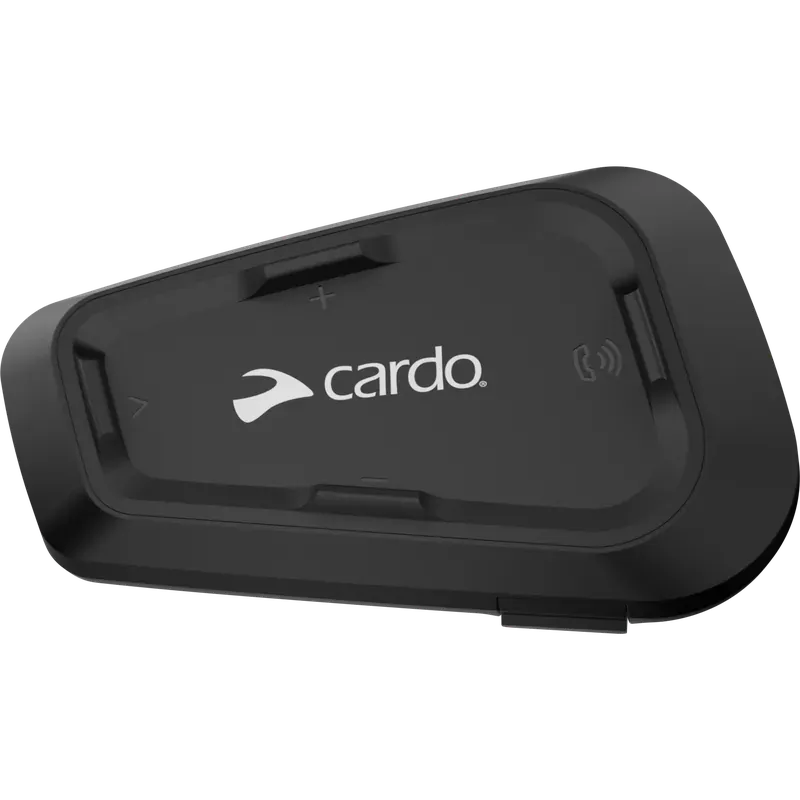
| Cardo Spirit HD | $161.96RevZilla. Price checked November 2026 | Bluetooth onlyUp to 2 riders | 600 m | 13 hrsclaimed | IP67 | 35 g |
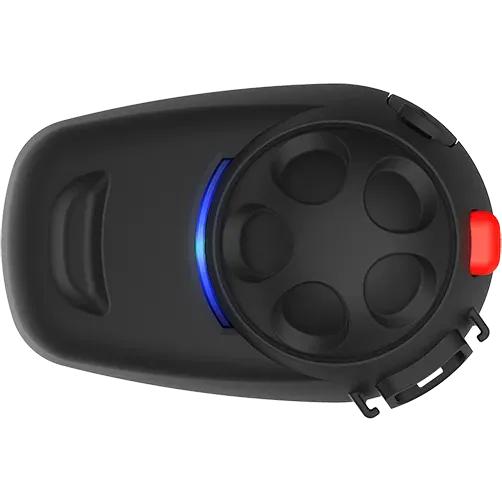
| Sena SMH5 | $89List price | Bluetooth onlyUp to 2 riders | 400 m | 8 hrsclaimed | No official rating | 40 g |
At the budget end, the Sena SMH5 is a two-rider intercom on Bluetooth 3.0: it does the job, but it shows its age next to current Bluetooth 5 units, and Sena publishes no waterproof rating for it.
The Cardo Spirit HD costs more and gives you Bluetooth 5.2, more claimed range and an IP67 rating. Both are two-rider units without mesh. If budget is the hard limit, the SMH5 does the job; if you can stretch, the Spirit HD is the better product. See our intercoms under $100 for more.
FAQ
Yes, but only over standard Bluetooth intercom pairing, not mesh. A Cardo Packtalk Edge and a Sena 50S can connect one to one for two-up riding. Each brand's mesh is proprietary, so a Cardo rider joining a Sena mesh group connects over Bluetooth intercom instead and does not get the mesh benefits.
Every Cardo model in our data carries IP67: dust tight and protected against immersion in up to 1 m of water for 30 minutes. Sena publishes no IP rating for the 50S. Some newer Sena models do carry a rating, for example IPX7 on the Sena 60S in our data.
Claimed battery: 13 hrs claimed for the Cardo Packtalk Edge, 13 hrs claimed for the Sena 50S. For the Cardo Packtalk Edge, WebBikeWorld measured about 6 hours of continuous intercom use in active mesh. We have found no comparable independent test of the Sena 50S, so for it we can only give Sena's figure. For long group days, carry a power bank either way.
Source: Cardo Packtalk Edge Communicator In-Helmet Review (WebBikeWorld, 2022), checked November 2026
Both flagships use branded speakers: JBL on the Cardo Packtalk Edge, Harman Kardon on the Sena 50S. We have not compared them by ear and know of no controlled test that settles it, so we do not pick a winner. Sound preference is personal; at speed, wind noise narrows any difference.
Both are mesh systems for group riding, and group size no longer separates them. Cardo's Mesh Boost update raises a Cardo DMC group on the Cardo Packtalk Edge from 15 to 31 riders. It needs unit firmware 5.4 or later and Cardo Connect app 9.1 or later on every unit; a group with any unit that has not been updated stays at 15. Sena Mesh 3.0 takes up to 24 riders in a private group on the Sena 50S.
Source: Mesh Boost FAQ (Cardo Systems), checked November 2026
Keep reading
DMC mesh, JBL audio, IP67, and the battery claim an independent test disputes.
Mesh 3.0, a longer claimed range, Harman Kardon audio, and the missing IP rating.
Our picks by riding style, beyond the two flagships.
What mesh networking really changes, and when Bluetooth is enough.